

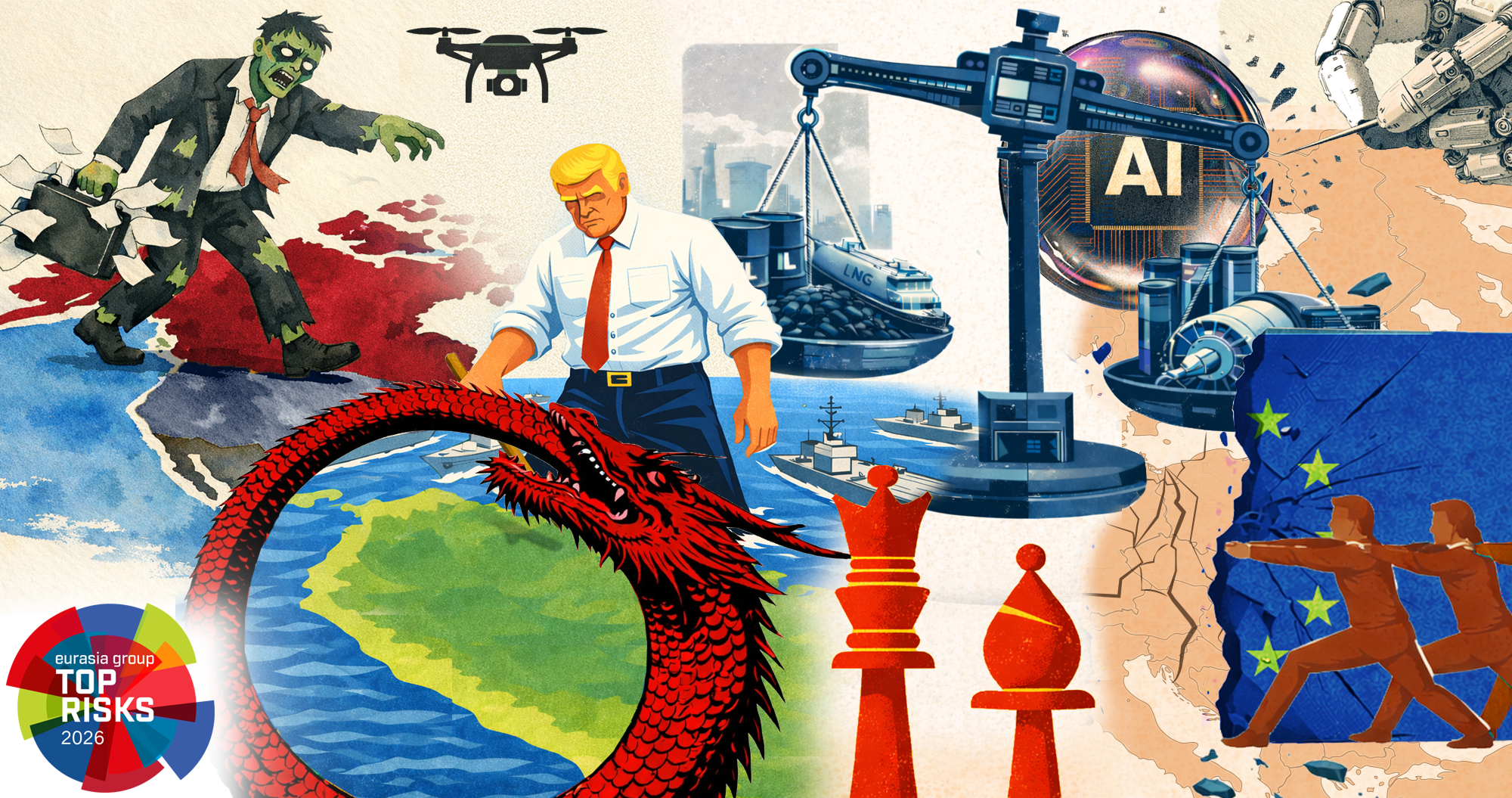
Eurasia Group's Top Risks of 2026
Top Risks is Eurasia Group's annual forecast of the political risks that are most likely to play out over the course of the year. This year's report was published on 5 January 2026.
Top Risks is Eurasia Group's annual forecast of the political risks that are most likely to play out over the course of the year. This year's report was published on 5 January 2026.
IMPLICATIONS FOR JApan
Among the top geopolitical risks in 2026, the biggest ones for Japan are those affecting its economy. Japan enters the year under economic pressure from inflation, a weak yen, and a growing debt burden (with interest rates at a 30-year high). Although Prime Minister Takaichi Sanae's approval ratings are remarkably strong, if she fails to address voters' economic concerns, she could see those numbers fall quickly. Takaichi has a tough task to tackle the high cost of living—the top issue for voters—while not tipping the weak economy into recession. And the implications of several of this year's risks (such as China's deflationary economy, US-Japan trade and investment relations, and the impact of US-Mexico-Canada trade negotiations on Japanese firms) will not make her job any easier.
Here are some of the key takeaways from this year's top risks for Japan. For the full report, please see Eurasia Group's Top Risks 2026.
RISKS THAT MATTER MOST FOR JAPAN
- Top Risk #7 (China's deflation trap) is Japan's most significant vulnerability in 2026, because China is Japan's top trading partner. The prospect of the start of a Japanese-style “lost decade” in China is unwelcome news for Japanese growth prospects this year.
- Chinese deflation will hurt the Japanese economy in two ways. First, fierce domestic competition will create a punishing environment for Japanese firms that do business there or export to China. Second, Beijing will unleash an even bigger wave of cheap products—such as electric vehicles (EVs)—on overseas markets than it did last year. Those products will compete against Japanese goods, especially in places such as Southeast Asia, putting pressure on the bottom lines of Japanese firms.
- One upside of a weak Chinese economy, however, will be that China may be less belligerent toward Japan. The year 2025 ended with a China-Japan row over Takaichi's comments about a Chinese invasion of Taiwan. China responded by clamping down on tourism to Japan, reimposing a ban on Japanese seafood imports, and engaging in military exercises around Okinawa. But a deflating Chinese economy may soften Beijing's approach toward Tokyo and reduce its military adventurism, improving diplomatic relations between the two countries.
- Japan will feel the effects of Top Risk #6 (State capitalism with American characteristics) as Washington awaits promised investments. In 2026, all the focus in the US-Japan economic relationship turns to whether Japan can ramp up investments in the US, which is its second-largest trading partner, and keep President Donald Trump from imposing new tariffs.
- To satisfy Trump, Japan has committed to invest $550 billion in the US by the end of Trump's presidential term. When Takaichi met Trump for the first time in October, the two leaders announced nearly $400 billion in potential investments involving both US and Japanese firms in the areas of energy, AI, and critical minerals. That is a good start. Still, Trump's watchful eye will be on Japan.
- That said, the Red herring (“Tariff Man” at large) should ease Japanese fears. The chaos from last April's Liberation Day tariffs will not return. Trump will still brandish tariff threats for leverage, but the shock-and-awe phase is now over. Relatedly, even though protectionist measures will continue to outpace liberalizing ones in 2026, it will not be the year of dismantling globalization, as another Red herring (Deglobalization) points out. That too is positive news for the Japanese economy, which reaps benefits from an interconnected global trading system.
OTHER RISKS
- Although less of a direct economic threat to Japan, Top Risk #1 (US political revolution) is nonetheless a headache for Japanese firms. Japan is the US's top foreign direct investor, so Japanese firms operate throughout the US and within its political system. They fret over Trump's unconventional approach, disregard for the rule of law, and flouting of process. As a result, Japanese firms must price their exposure to the US government into key 2026 business decisions.
- Two risks this year, importantly, will pose challenges to Japan's top industry—the automobile sector. Many Japanese automakers operate in Mexico, exporting into the US market. Unfortunately for them, the days of free and predictable North American trade are over. Those firms will be closely watching how the renegotiation of the US-Mexico-Canada Agreement (USMCA) proceeds this year, as discussed in Top Risk #9 (Zombie USMCA).
- Washington's fixation on preventing China from using Mexico as a backdoor to export Chinese goods into the US will be the top focus of the negotiations. Tightened restrictions on automobiles and automobile parts exports from Mexico to the US would complicate the business models of Japanese automakers. Also, the chronic uncertainty over the USMCA will trouble Japanese firms and disrupt their planning. The good news for Japanese firms, nevertheless, is that Mexico and Canada will still face lower effective tariff rates than most of the world.
- The other concern for Japanese automakers must be Top Risk #2 (Overpowered). At the end of 2025, Chinese automakers were set to take the top spot in global new vehicle sales for the first time, pushing aside Japanese manufacturers, which have held that position for more than 20 years. Japanese auto firms are falling way behind when it comes to EVs, while Chinese firms race ahead. And as Japanese automakers continue to focus on manufacturing hybrids and gasoline-powered cars for the US market, they will only fall further behind. In Indonesia, for example, Chinese EV brands are surging, rapidly capturing market share as Japan's once-dominant share declines.
- Although the economic implications of this year's risks are the most important for Japan, foreign policy risks also exist. Top Risk #3 (The Donroe Doctrine) is of concern to Japan, because of Trump's primary focus on the Western Hemisphere. Japan always wants Washington's top focus to be on the Indo-Pacific (and countering China), so a shift in attention to the Western Hemisphere is not something that Tokyo welcomes.
- Here, the Red herring (Spheres of influence), however, may help to assuage Japan's anxiety. Despite the rhetoric of withdrawal from the world, American interests remain stubbornly global. US defense spending keeps breaking records. Despite a détente with China on trade, the US military posture in the Indo-Pacific has not weakened; for instance, Washington just sent Taipei its largest-ever arms sale package. Those kinds of actions speak volumes to Tokyo.
- Despite the Russia-Ukraine war being far away, Top Risk #5 (Russia's second front) has implications for Japan. First, Japan views the war through the lens of whether the US will stand up to Russian aggression—and draws conclusions from that as to how the US would respond to similar circumstances in the Indo-Pacific region. Second, Japan also must consider its own energy security. Japan still imports about 9% of its LNG from Russia's Sakhalin-2 facility. It has steadfastly maintained that it will not pull out from that facility, despite Russia's near-pariah status. And that is not likely to change in 2026, even while Tokyo hopes that the rising odds of a cease-fire may prevail.
- Japan's stock market was a bright spot in 2025, performing extraordinarily well, in part because Japanese AI-related and semiconductor firms had banner years. Japan is eager to invest even more in the US when it comes to AI, despite the warnings in Top Risk #8 (AI eats its users). It is one of the priority sectors under the US-Japan agreement on investment. But if the AI bubble bursts in 2026, that would spell trouble for those Japanese firms.
- Finally, Top Risk #4 (Europe under siege) could have meaning for Japanese domestic politics as populist sentiment percolates in the background. The fury seen in Europe over immigration and declining living standards also exists in Japan, and that anger is stoking right-wing populism. For now, however, Takaichi's own conservative policy positions have effectively co-opted those of the right-wing populist Sanseito party. Sanseito's support levels are sagging after hitting record highs this summer, which had led it to gain seats in the upper house election. As 2026 starts, the rise in right-wing populism in Europe looks unlikely to take hold in Japan. But Tokyo's politicos will be watching carefully.