

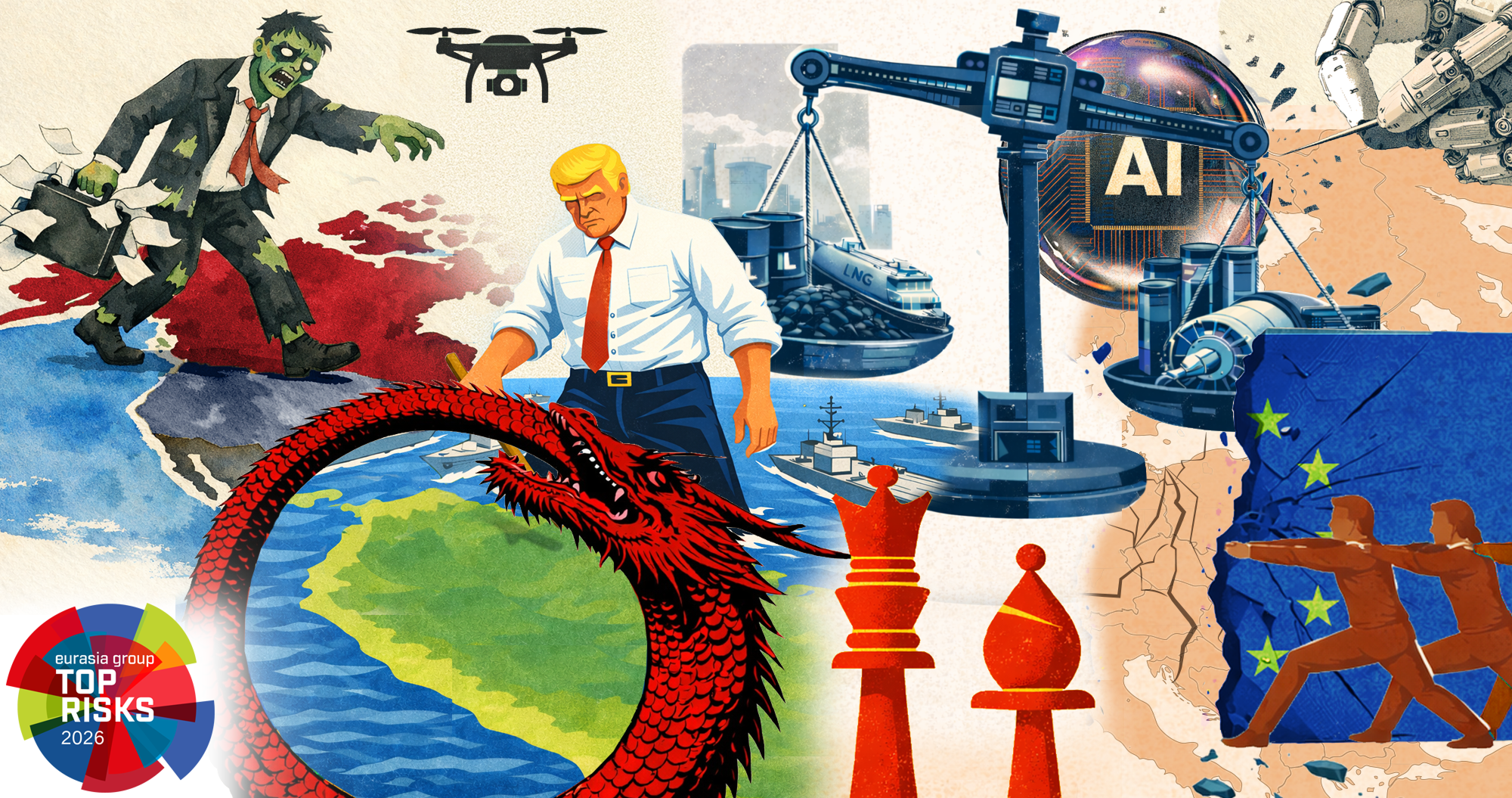
Eurasia Group's Top Risks of 2026
Top Risks is Eurasia Group's annual forecast of the political risks that are most likely to play out over the course of the year. This year's report was published on 5 January 2026.
Top Risks is Eurasia Group's annual forecast of the political risks that are most likely to play out over the course of the year. This year's report was published on 5 January 2026.
IMPLICATIONS FOR Europe
Almost all the 2026 Top Risks hit Europe at its weakest points, contributing to the perfect storm that has been gathering in the G-Zero era. Distraught European leaders will fail to address structural political and economic problems, fueling populist threats. Both Russia and the US will support illiberal, nationalist parties across Europe. The EU and the UK will make only piecemeal progress toward revamping economic competitiveness and bolstering security. Europe will face outright political hostility from the US—its erstwhile NATO ally—while dealing with Russia's war against Ukraine. China's troubles and export-oriented economic model will compound Europe's industrial hardships. Delivering on the green and digital transitions key to Europe's continued global relevance will become more difficult. Turkey will be an exception, benefiting from geopolitical shifts despite continued democratic backsliding.
Here are some of the key takeaways from this year's top risks for Europe. For the full report, please see Eurasia Group's Top Risks 2026.
RISKS THAT MATTER MOST FOR EUROPE
- Top Risk #1 (US political revolution) will have an outsized impact on the EU. President Donald Trump's moves will further undermine the rules-based global order that the EU relies on. This will fuel populist sentiment and provide political room for euroskeptic leaders to test the bloc's core principles. The UK and Turkey are likely to face fewer challenges than the EU and its members in managing the fallout from US domestic turbulence.
- Top Risk #4 (Europe under siege) will manifest in France, Germany, and the UK, threatening paralysis and destabilization. Without effective leadership from its three major powers, Europe risks prolonged economic malaise and diplomatic irrelevance. The biggest domestic downside will be further erosion of the postwar political order and the rise of extremist movements, a development the Trump administration will almost certainly support. Externally, economic competitiveness and countering conflicts will be the major challenges.
- Top Risk #5 (Russia's second front) will exacerbate Europe's challenges. An overwhelming majority of EU countries—especially in Eastern Europe and the Nordics—as well as the UK will be particularly exposed to Russian escalation. Washington's unwillingness to antagonize Moscow will undermine a strong NATO response, providing more room for Russian probing and raising the risk of a direct confrontation. European defense readiness will be tested more than it has ever been since the collapse of the Soviet Union. In contrast to its western neighbors, Turkey will benefit from continued good relations with the US, Ukraine, and Russia—which will position Ankara to largely avoid the risk of a widening war.
- Top Risk #7 (China's deflation trap) will hit the EU and undermine Brussels's competitiveness push. Beijing's efforts to export its way out of economic problems serve two goals: to alleviate challenges at home and to destroy Europe's industrial base. Both objectives will put severe pressure on key European industries. Green industries and the EU's decarbonization agenda will face a bleak trade-off between higher-priced European products versus cheap Chinese goods decimating local businesses. This will stoke EU-China trade tensions and drive more European protectionism.
- Top Risk #2 (Overpowered) will compound Europe's competitiveness pressures at a time of growing anti-green backlash. European leaders will struggle to stick with longstanding climate and sustainability goals, weakening the business incentives to accelerate the green transition. Political pushback from its member states risks hampering the EU's ability to pursue more proactive industrial and trade policies to support key sectors. As the US and China battle for supremacy in the electro-tech age, Europe will risk becoming merely a client with no global sway in digital and green technologies.
- Top Risk #8 (AI eats its users) will make it even harder for European tech firms to catch up with US and Chinese industry leaders. Similarly, achieving European digital sovereignty will become more difficult, as leading US firms roll out even more disruptive products. European policymakers will face the task of improving the regulatory landscape while grappling with simplification measures to foster more domestic start-ups and scale-ups. AI adoption and dealing with the fallout will remain challenging, with elections emerging as bellwether battlegrounds.
- Top Risk #6 (State capitalism with American characteristics) will heap more economic pressure on Europe. Trump's moves will put the EU in the awkward position of playing by rules the US and China no longer respect—fair competition and market liberalization. EU members will shudder at the thought of centralizing powers in Brussels to counter state capitalism from not only China but also the US. This risks further widening the competitiveness gap between Europe and its chief economic rivals.
- Top Risk #3 (The Donroe Doctrine) risks accelerating US disengagement from Europe at a time when its defenses remain weak. The US is highly unlikely to rapidly withdraw from its role as Europe's ultimate security guarantor. However, Washington's pivot to its neighborhood and focus on China will mean growing demands on European allies to shoulder a greater share of the defense burden. This threatens to shorten the timeline—previously considered a decade or longer—for Europe to develop a more autonomous security architecture. Trump's desire to disengage from Europe will expand Turkey's maneuvering room to take on more regional responsibility and pursue national interests.
- Top Risk #10 (The water weapon) will be somewhat less pressing for Europe in 2026. That said, declining water levels, combined with shallow rivers disrupting transportation, and new industries requiring more water for cooling, will test EU cohesion. Existing regimes will help Europeans manage internal challenges, but political constraints will limit their ability to address the issue globally, as water-related conflicts and migration increasingly place strains on Europe. Turkey will continue to use its position as the source of the Euphrates and the Tigris to pressure its southern neighbors in pursuit of its diplomatic and security objectives—particularly in Syria and Iraq.
- Top Risk #9 (Zombie USMCA) and Trump's trade demands will undermine European businesses. Uncertainties will continue to weigh on European investment decisions. More big players—from automotive to chemicals and pharmaceuticals—will consider expanding US operations to sidestep tariff risks and political volatility. This will undermine efforts by the EU and the UK to bolster strategic industries and protect their industrial bases.