

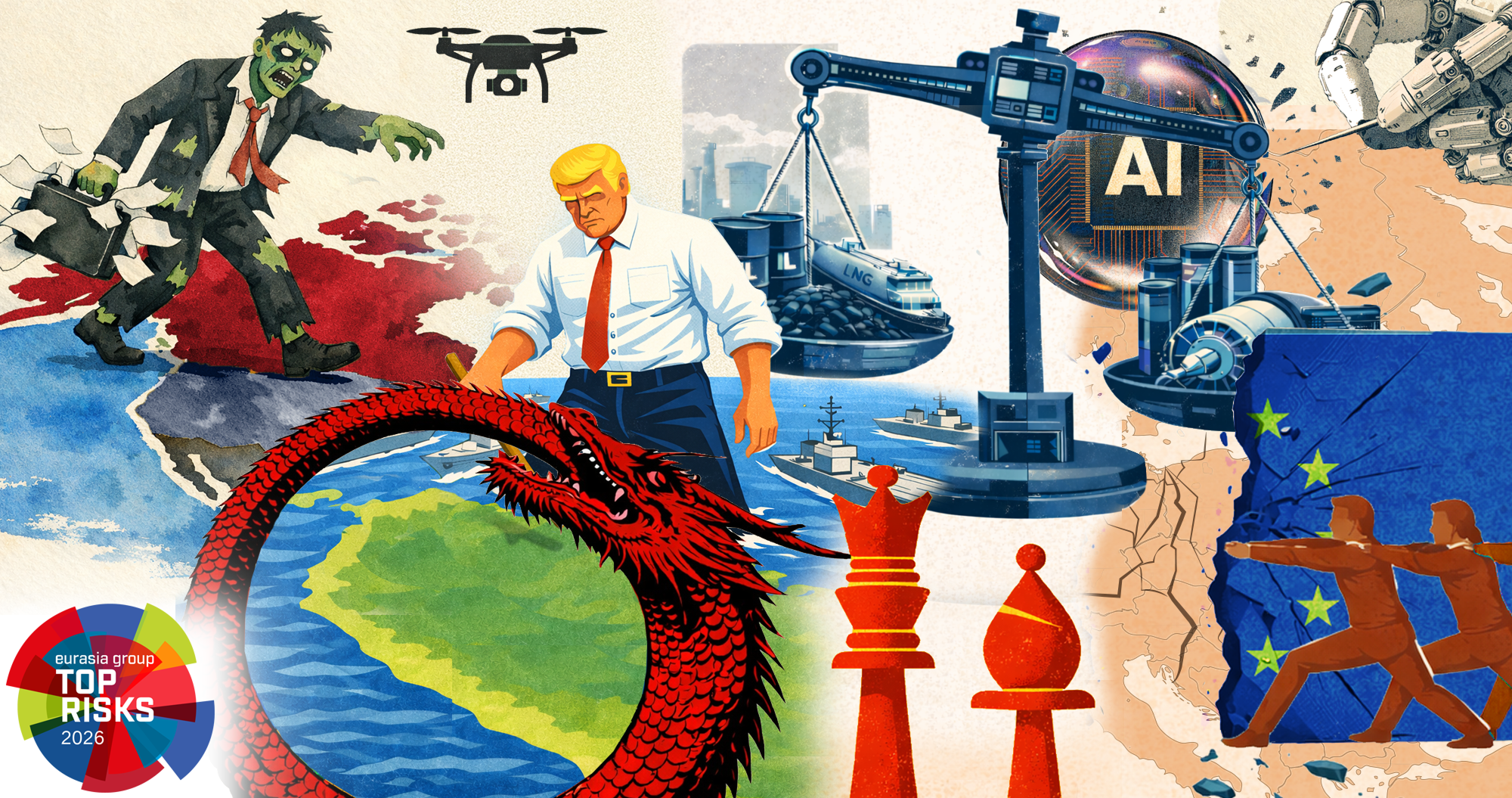
Eurasia Group's Top Risks of 2026
Top Risks is Eurasia Group's annual forecast of the political risks that are most likely to play out over the course of the year. This year's report was published on 5 January 2026.
Top Risks is Eurasia Group's annual forecast of the political risks that are most likely to play out over the course of the year. This year's report was published on 5 January 2026.
IMPLICATIONS FOR CANADA
Canada enters 2026 at what Prime Minister Mark Carney has rightly called a “hinge moment” in its history. Its powerful neighbour to the south is undergoing a political revolution, with President Donald Trump rapidly unwinding the US-led global order. Outside the US, no other country will be as profoundly affected by Eurasia Group's Top Risk #1 (US political revolution) as Canada. Its long-standing relationship with the US, based on ever-increasing economic integration and a rock-solid security partnership, is history. Ongoing trade uncertainty will weigh on the Canadian economy, and the Trump administration will wield unilateral US power in the Western Hemisphere. Canada's efforts to diversify its trade and strategic relationships will face powerful headwinds–many reflected in this year's Top Risks. The challenge for Ottawa—and Canadian firms more broadly—will be to play defence and offence at the same time: managing an unpredictable and unreliable US while carving out new roles in an increasingly unstable G-Zero world.
Here are some of the key takeaways from this year's top risks for Canada. For the full report, please see Eurasia Group's Top Risks 2026.
RISKS THAT MATTER MOST FOR CANADA
- Top Risk #1 (US political revolution) is the key driver of political and economic risks to Canada in 2026. Trump's systematic effort to dismantle checks on his power and weaponize the machinery of government against his political enemies will inevitably reshape not only Canada-US relations, but the Canadian economy and Canadians' engagement with the rest of the world.
- Trump's political revolution calls assumptions underpinning Canadian foreign, trade, and defence policy into question. For decades, Ottawa was comfortable with ever-deeper integration with the US. Canadians seamlessly navigated the US political system, cultivating allies from the White House through Congress to state governors' mansions. And reliance on the world's largest and most dynamic economy, greatest military power, and democratic leader paid off. That calculation no longer holds.
- The US-Canada relationship will be unusually personalized and volatile, leaving businesses exposed to potential backlash. Washington now turns on the whims of a single, mercurial man and an administration committed to implementing a radical new vision of American governance. That will spill over in unpredictable ways; any perceived slight from Ottawa risks inviting punitive action. Canadian companies and investors could become collateral damage in the US political revolution.
- For continued US market access, Canadian officials and firms will need to navigate Top Risk #9 (Zombie USMCA). The United States-Mexico-Canada Agreement (USMCA, or CUSMA) will not be formally renegotiated, extended, or terminated in 2026—it will stagger on as a "zombie," neither fully dead nor alive. The good news is that tariff exemptions for CUSMA-compliant goods will keep free trade on life support, leaving Canada (and Mexico) with lower average effective US tariff rates than much of the world. The bad news is that Trump will use sectoral tariffs on goods such as autos, steel, and aluminum—sectors he is bent on reshoring to the US—as leverage in endless negotiations, where Washington will seek to divide and conquer Ottawa and Mexico City.
- To make things worse, Trump does not like Canada's tough, detail-oriented approach to trade negotiations. Carney will struggle to sell the kind of concessions on market access or defence purchases that Trump could tout as a win. While Carney's promises of new infrastructure projects and “buy Canadian” procurement could build economic resilience over the long term, they will not ease near-term tariff pain for Ontario automakers, Quebec aluminum producers, or British Columbia loggers. Firms that built continent-wide production lines and export strategies will face another year of trade uncertainty, and the rest of the Canadian economy will feel the chill.
- Top Risk #6 (State capitalism with American characteristics) will compound the economic risks to Canada. Trump's emerging system of extracting payments, equity stakes, and investment-for-tariff-relief deals from governments and companies will continue to degrade the business environment in the US while heaping pressure on Canadian firms to participate in the pay-to-play model. That will create a perverse incentive structure in which companies that operate above board will be disadvantaged in what is still the world's largest and most innovative economy and consumer market.
- Top Risk #3 (The Donroe Doctrine) implies a fundamental shift in Canada's geopolitical environment. Trump's assertion of US primacy in the Western Hemisphere will keep Canada on the defensive, with Carney forced to balance the defence of Canadian sovereignty with the reality of strategic dependence on the US. In that context, the reconstruction of the Canadian Armed Forces—with a focus on Arctic capabilities and infrastructure—will be an urgent priority, with Ottawa working to build domestic capacity, partner with European NATO allies, and show the US that it can defend its own backyard. Canadians should also watch US intervention in Venezuela closely: With Maduro's ouster, Venezuelan heavy crude oil could begin to displace Canadian crude exports to the US over the long term.
OTHER RISKS
- Canada's efforts to diversify its trade and defence partnerships away from the US will face challenges from Top Risk #4 (Europe under siege). Governments in the UK, France, and Germany are weak, divided, and focused on short-term survival in the face of resurgent political radicalism on both the left and the right—as well as a fundamentally hostile US administration. While Carney has prioritized ties with non-US NATO allies, Ottawa's three most important European partners will have their hands full in 2026. All three face paralysis at best and destabilization at worst—and at least one government could fall before the year is over.
- Meanwhile, Eurasia Group's Top Risk #5 (Russia's second front) will expose Canada to Russian hybrid attacks. Canadian military personnel are serving with NATO forces in the Baltic states on the front line with Russia, and Ottawa has long been a vocal contributor to Ukraine's defence against President Vladimir Putin's illegal invasion—both of which make Canada a target for Moscow's grey-zone activities. While Europe's rearmament will create opportunities for Canada and Canadian firms to deepen strategic and commercial ties with the continent, pressure on NATO states to respond to Putin's provocations risk pulling Canada into a NATO-Russia crisis this year.
- Top Risk #7 (China's deflation trap) will exacerbate Canada's trade diversification challenge. China's economy is stuck in a trap of its own making, with prices, consumer confidence, investment, and demand spiralling downward—and Beijing will not do anything to stop it. Instead, state-driven investment has created overcapacity in high-tech manufacturing, which is now being dumped on the rest of the world—part of the reason why Canada still has 100% tariffs on Chinese electric vehicles (EVs). Reducing those tariffs would mean affordable EVs and reduced Chinese tariffs for Canadian goods such as canola, but it would hit the Ontario auto sector with cheap competition while risking blowback in trade talks with the US. And weak Chinese economic activity means sub-par demand for Canada's abundant natural resources. It is a no-win situation for Ottawa.
- Relatedly, Top Risk #2 (Overpowered) will pull the Canadian economy in two directions. On one side, China is cementing its dominance in clean energy technologies such as EVs, batteries, and solar power; on the other, the US is doubling down on its fossil fuel export and consumption model. The Carney government has decided to do both: using tax credits and other incentives to attract investment into clean energy technologies, critical minerals, and domestic manufacturing, but pivoting back towards fossil fuel exports and infrastructure in search of economic growth and energy peace with Alberta and Saskatchewan. Time will tell if the strategy pays off.
- Top Risk #8 (AI eats its users) embodies the risks and opportunities for Canada in building domestic AI capacity. Many leading (mostly American) firms are pursuing extraordinary AI capabilities but shifting towards extractive and socially dysfunctional business models to do so. With little regulation governing their behaviour, the Trump administration is likely to lash out at countries that impose their own standards on US tech firms. We have already seen that with Canada's Digital Services Tax, as well as legislation governing online streaming and news—currently among the thorniest issues in bilateral trade talks. Yet much of AI's potential will come from smaller, leaner, purpose-built models—exactly the niche where Canada's AI ecosystem is positioned to thrive. If Canada can withstand US pressure and sustain the funding necessary to develop and retain AI talent, there is no ceiling on the future growth of the Canadian sector.