
Eurasia Group's Top Risks of 2026
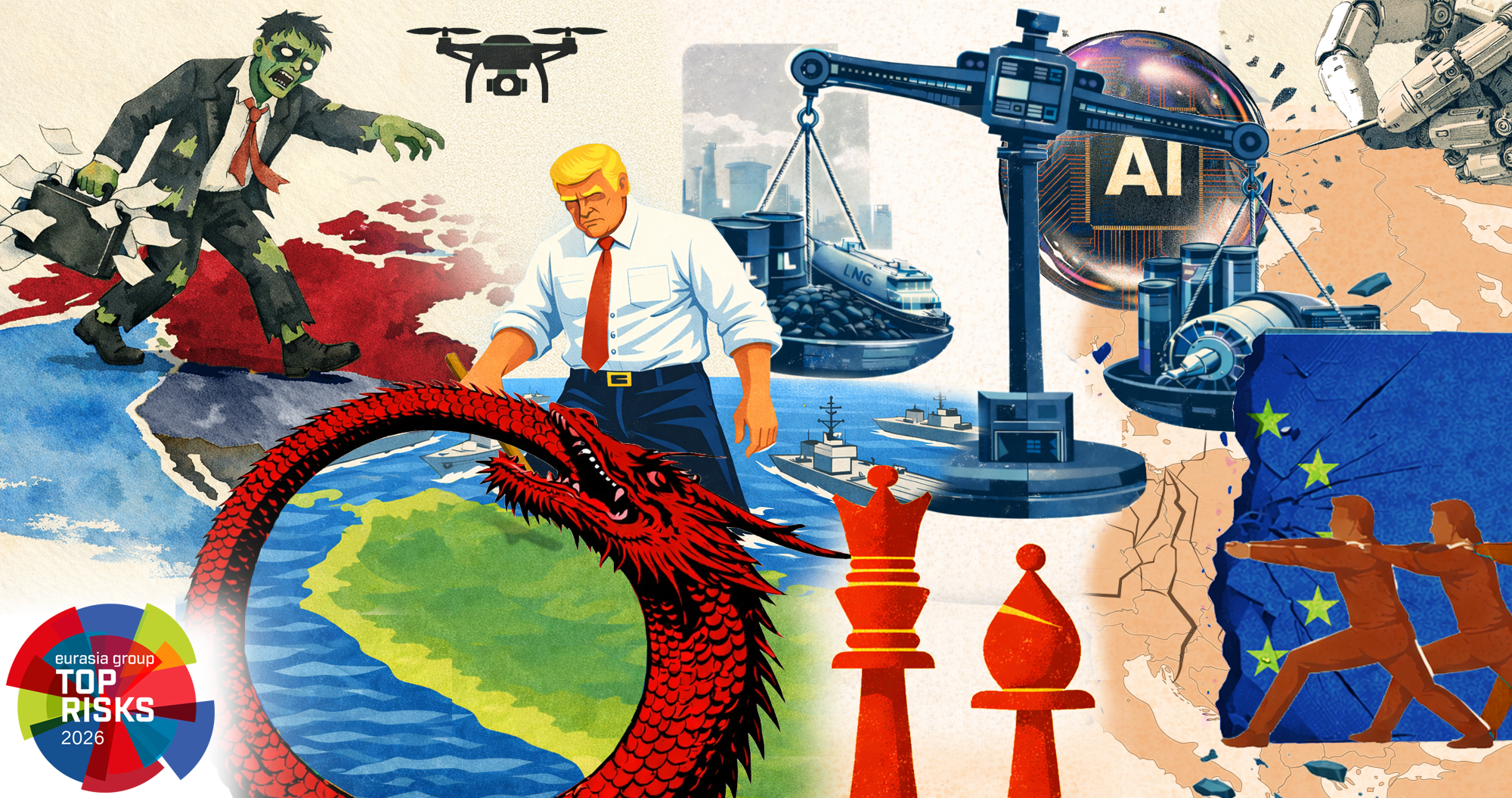
Top Risks is Eurasia Group's annual forecast of the political risks that are most likely to play out over the course of the year. This year's report was published on 5 January 2026.
Top Risks is Eurasia Group's annual forecast of the political risks that are most likely to play out over the course of the year. This year's report was published on 5 January 2026.
IMPLICATIONS FOR Brazil
Eurasia Group's Top Risks for 2026 will have a modest impact on Brazil, with some even benefiting the country in the near term. Yet Brazil's 2026 elections will be very competitive and decisive for its political outlook, and global risks have the potential to tilt the balance in one direction or the other. Four risks will weigh more heavily on Brazil. First, China's deflationary spiral presents near-term inflation benefits but brings medium-term vulnerabilities in commodity-dependent exports. Second, Brazil's 2026 electoral cycle will test AI-driven disinformation in a highly polarized democracy with untested regulatory frameworks. Third, Brazil's strategic positioning—exporting fossil fuels while expanding renewable capacity and possessing critical minerals—provides unusual leverage in navigating US-China technological competition. Fourth, though Brazil is relatively insulated from Top Risk #3 (The Donroe Doctrine), action in Venezuela could delay a US-Brazil bilateral agreement.
Here are some of the key takeaways from this year's top risks for Brazil. For the full report, please see Eurasia Group's Top Risks 2026.
RISKS THAT MATTER MOST FOR BRAZIL
- Top Risk #7 (China's deflation trap) is perhaps the most consequential for Brazil, with some short-term benefits alongside medium-term concerns. As Brazilian Central Bank President Gabriel Galipolo acknowledged in December, China is "exporting disinflation" to Brazil, with import volumes increasing while prices decline. Chinese imports lower manufactured goods prices, tame inflation, and enable faster monetary easing, which is good news for President Luiz Inacio Lula da Silva's reelection campaign.
- However, this relief masks fundamental medium-term vulnerabilities and some near-term pain points. Weakened Chinese demand will reduce appetite for Brazilian commodity exports, particularly iron ore—Brazil's most valuable export to China. Brazil has pursued diversification through trade agreements, but no clear substitute for the Chinese market exists. The policy challenge is managing short-term inflation benefits while accelerating structural diversification.
- In the near term, Brazil's manufacturing sector will also continue to suffer from Chinese imports. The most affected sectors are steel, petrochemicals, apparel, and automotive.
- Top Risk #8 (AI eats its users) will feature in Brazil's elections this year. The country enters the 2026 electoral cycle with recently implemented but untested regulatory frameworks. While AI itself lacks comprehensive regulation, Brazil's electoral court (TSE) has established clear prohibitions: deepfakes created to favor or harm candidates are banned (with penalties including potential loss of office); using AI to create false content about candidates or electoral processes is prohibited; and chatbots simulating candidates are also forbidden.
- Despite this architecture, practical enforceability in the context of rapid technological evolution will be a challenge. The 2024 Sao Paulo mayoral race highlighted these challenges when Pablo Marcal's campaign forged a document; though he was eventually penalized, the episode had already generated electoral consequences.
- Beyond direct campaign use, AI presents subtler threats; as Brazilian voters increasingly query AI systems for candidate information—particularly for legislative races where decisions concentrate near election day—algorithmic influence operates through channels no authority can effectively monitor.
- This uncertainty is compounded by Brazil's political polarization and widespread institutional distrust. With Kassio Nunes Marques assuming TSE leadership in 2026, questions will arise about enforcement posture. Overly aggressive judicial action against right-wing candidates could trigger US tensions (discussed below), while insufficient enforcement could allow AI-driven disinformation to distort electoral outcomes.
- Top Risk #2 (Overpowered) outlines China's dominance in 21st-century energy technologies, which positions Brazil unusually well. The latter occupies a unique niche: simultaneously expanding oil exploration and exports while maintaining an overwhelmingly renewable electricity matrix and developing next-generation low-carbon technologies, including advanced biofuels and battery production.
- Brazil's energy sector is attracting substantial Chinese investment, with approximately 70% of Chinese FDI concentrated in sustainability and green energy. Access to Chinese renewable technology at competitive prices accelerates Brazil's low-carbon transition without abandoning economically valuable oil production. Recent battery frameworks position Brazil to increase capacity for energy storage, leveraging Chinese technology and capital for Latin American markets.
- However, US challenges to international aviation and maritime transport regimes create uncertainty for Brazilian sustainable aviation fuel (SAF) and biobunker opportunities. The partial rollback of the Inflation Reduction reduces investment incentives in nascent technologies such as SAF and green hydrogen where Brazil could become a major producer. Brazil may become a refuge for low-carbon technology production facing US barriers, but reduced American market access could constrain development. The net effect is likely positive—Brazil gains technology access and investment—but falls short of transformational opportunity.
- Top Risk #1 (US political revolution), with President Donald Trump's systematic dismantling of checks on executive power, poses economic and political tail risks. Economically, the "Trump 2.0" effect proved largely benign through 2025: US growth remained resilient while the dollar weakened, facilitating Brazilian inflation reduction. The question for 2026 is whether this continues or whether rising US political uncertainty generates negative spillovers, particularly if doubts about US fiscal sustainability trigger risk-off behavior.
- Brazil remains structurally vulnerable to external shocks absent stronger domestic fiscal consolidation. Current fiscal trajectories leave Brazil exposed to sudden shifts in global risk appetite, with limited policy space to cushion shocks. The US policy mix—expansive fiscal policy, trade restrictions, and Federal Reserve pressure—creates greater risks that the supportive backdrop for emerging market economies like Brazil may not continue.
- Top Risk #3 (The Donroe Doctrine) will affect the region, but Brazil's strategic importance provides meaningful insulation. As the military incursion in Venezuela made evident, Washington is reasserting US primacy in the Western Hemisphere through military pressure, economic coercion, and selective alliance-building. Yet Brazil's possession of critical minerals essential for advanced technology manufacturing, combined with economic scale and regional influence, positions it differently than smaller Latin American states facing more direct pressure.
- The US decision to levy punitive 40% tariffs on Brazil's imports in 2025 provided a revealing lesson: US trade pressure strengthened rather than weakened Lula's domestic political position. This outcome was noted within the Trump administration and contributed to a partial withdrawal of the tariffs.
- The US's retreat was also motivated by Brazil's rich deposits in critical minerals and rare earths. The White House's desire to normalize ties with Brazil is driven by the imperative to reduce its dependence on Chinese critical minerals.
- The US military incursion in Venezuela will strain Brazil's relationship with Washington and will likely delay a bilateral deal on trade and critical minerals—but not undermine its likely conclusion.
- However, the Trump administration prefers right-wing electoral victories across Latin America, and Brazil's 2026 elections will be closely watched. The most significant risk involves potential US reactions to Brazilian Supreme Court actions perceived as politically biased against right-wing candidates. If the TSE aggressively moves against conservative candidates—whether on AI usage grounds or through broader attempts by right-wing candidates to delegitimize the courts—it could encourage US support for opposition candidates. But any response that is seen as overt or undue interference could have the unintended consequence of benefiting Lula's reelection bid.
- Top Risk #4 (Europe under siege) presents limited direct near-term impact, particularly if the EU-Mercosur agreement is finalized before European political crises deepen. However, European instability complicates Brazil's multilateral engagement on climate, trade, and human rights. Increased European protectionism could also threaten EU-Mercosur implementation even after signing.
- Top Risk #5 (Russia's second front) could affect Brazil as gray-zone escalation and the risk of direct Russia-NATO confrontation could disrupt commodity flows. Particular vulnerabilities include Russian fertilizer exports (critical for agriculture) and energy markets where Russian supply disruptions would increase global prices and import inflation.
- Risk #10 (The water weapon) represents a significant long-term trend, but Brazil faces limited direct 2026 exposure. The most significant vulnerability lies in potential Sao Paulo state water stress, where supply restrictions dependent on rainfall could generate economic disruption and political consequences during the electoral cycle, potentially harming Governor Tarcisio de Freitas's center-right coalition.
- Top Risk #9 (Zombie USMCA) presents modest positive opportunities as Mexico and Canada seek alternative relationships. Ongoing Mercosur negotiations with both countries reflect this dynamic, with potential for enhanced Brazilian market access as the USMCA's reliability deteriorates.
- Top Risk #6 (State capitalism with American characteristics) could have second-order effects on how Brazilian companies operate in the US; they are likely to face a more uneven playing field with their US competitors.