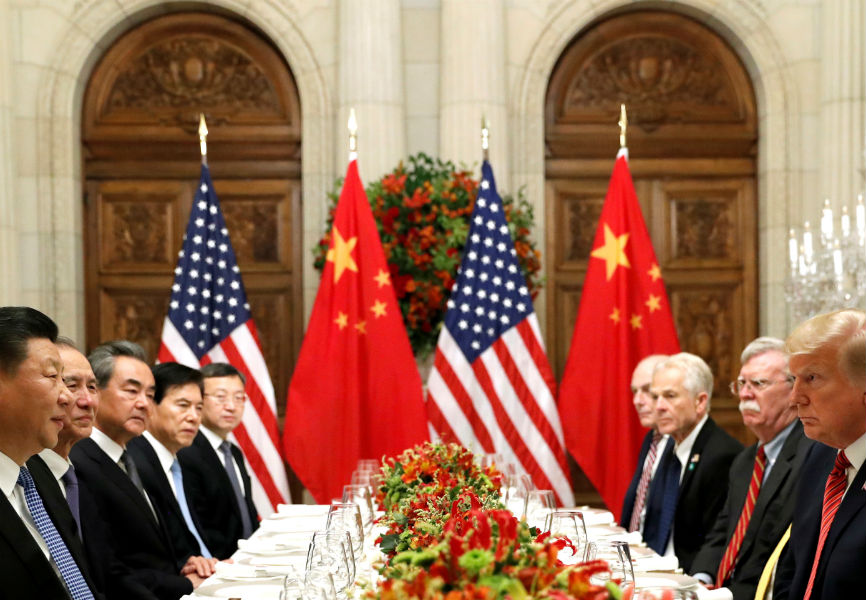
 U.S. President Donald Trump, U.S. Secretary of State Mike Pompeo, U.S. President Donald Trump's national security adviser John Bolton and Chinese President Xi Jinping at a working dinner after the G20 leaders summit in Buenos Aires on Dec. 1, 2018. REUTERS/Kevin Lamarque
The risk is that Trump—-increasingly embattled at home by midterm election setbacks and a new Democratic Party majority in the House, plus expectations that special counsel Robert Mueller is preparing to show his work—will look for foreign policy wins that aren't really there.
And even if Trump is successful in forcing some changes in China's behavior and restoring balance to the U.S.-China commercial relationship, there's a more serious long-term problem: the biggest issue that divides the two governments—China's encroaching global ambition—is effectively off the table.
Xi has made clear that he will not approve any economic plan that he believes might undermine the Communist Party's power or create instability inside China. So whatever concessions he might offer Trump, he will not loosen the leadership's grip on China's economic development. State-owned companies will still help the government generate economic growth and maintain jobs. The state will continue to use cash and political clout to boost China's private sector.
In addition, China will expand its Belt and Road development strategy of large-scale investment in foreign countries, extending Beijing's economic and political influence abroad as the U.S. long-term commitment to its regional allies wavers. More important, Xi will continue to protect plans that allow China to compete for access to, and development of, the emerging information and communication technologies crucial for both national security and prosperity in the 21st century.
For Xi, these things are nonnegotiable, no matter the skill of the dealmaker seated across the diplomatic dinner table.